Sunday, September 29, 2013

#LiquorLeaks wonders: what is the booze review endgame?

Parliamentary Secretary John Yap -- yes, the same Freedom of Information-subverting John Yap who quit cabinet amid the Quick Wins scandal -- pushed the button on a glitzy website and social media campaign on Sept. 14 to elicit public opinion on changes to B.C. liquor laws.

The cash-strapped BC Liberal government is desperately seeking to cut costs and increase revenue, and the Liberals think booze can help it tick both boxes. While the Legislature stays dark for the fall because Premier Christy Clark would rather not face Question Period, the ruling party is exploiting the eternally divisive debate over liquor policy to help divert attention from political minefields, like troubled BC Hydro and its imminent rate hikes. 

Yap will be reporting recommendations by the end of November to Attorney General/liquor minister Suzanne Anton, who is quietly plotting the transformation of the Liquor Distribution Branch into a Crown agency or corporation. Every other province has such a body, either as a standalone organization or merged with its lotteries and gambling monopoly. 

More changes are coming to LDB. On Sept. 13, LDB quietly confirmed that it contracted Sedlak Management Consultants of Cleveland, Ohio to create the business case for moving out of the Vancouver Main Distribution Centre and into a new warehouse somewhere in the Lower Mainland. Sedlak’s website says it has worked closely with BC Liberal-connected Exel -- the same company that lobbied for privatization for seven years

Eighteen companies responded to the supply chain management expert request for proposals and the list is below. But LDB won’t disclose the names of the two companies on the shortlist with Sedlak and its explanation why is vague.  

What is the endgame for this whole exercise, especially the contracting of Sedlak, a company that makes no secret of its connection to Exel? Perhaps a second sip of privatization? Read my analysis in The Tyee here.
LDB hires supply chain management expert to help find a new main warehouse location 
Successful Proponent:
·         Sedlak Management Consultants, Inc. 

Unsuccessful Proponents:
·         BizTechMasters Inc.
·         CGI Information Systems and Management Consultants Inc.
·         CGR Management Consultants, LLC
·         Deloitte Inc.
·         Devencore Company Ltd. dba Newmark Knight Frank Devencore
·         IBM Canada Ltd.
·         KOM International Inc.
·         KPMG LLP
·         Kurt Salmon Canada Ltd.
·         LIDD Consultants Inc.
·         Metro Supply Chain Group
·         Protiviti Inc.
·         PricewaterhouseCoopers LLP
·         Sierra Systems Group Inc.
·         Stantec Consulting Ltd.
·         Tompkins Associates, Inc.
·         Trybec Management Services, Inc

Friday, September 27, 2013

One year later: Furlong case fraught with accusations and denials


One year ago, on Sept. 27, 2012, the world of John Furlong was turned upside down and Vancouverites who followed his rise were shocked. 

The Georgia Straight published an expose by Ontario journalist Laura Robinson that revealed Irish-born Furlong lived in Canada before his oft-stated 1974 arrival in Edmonton. He had been a Catholic missionary volunteering as a physical education teacher of aboriginal children at the Immaculata Catholic elementary school in Burns Lake in 1969 and 1970, before moving to Prince George. Some of those ex-students claimed that he abused them and ruined their childhood. 

As CEO of the Vancouver 2010 Winter Olympics organizing committee, Furlong was the head organizer of the biggest, most-expensive and complex Winter Olympics in history. Furlong was the British Columbian who formally welcomed the world at the opening ceremony on Feb. 12, 2010 and he thanked the world for coming on Feb. 28, 2010 at the closing ceremony. The International Olympic Committee estimated 1.8 billion people watched during the 17 days of Vancouver 2010. Furlong was showered with acclaim before, during and after: honorary university degrees, corporate board appointments and even his name was emblazoned on a SkyTrain car. 

Never before -- and, perhaps, never again -- will British Columbia be so united as it was during February 2010 and Furlong was at the centre of it all. He also became a lightning rod for criticism, whether it was VANOC’s secrecy, its adverse impact on some communities and the environment, the cost of it all, VANOC's finances amid the Great Recession and the preventable death of Georgian luger Nodar Kumaritashvili. 

Within hours of the Georgia Straight story hitting the streets and the web, Furlong appeared at a news conference in The Landing in Gastown. A building of significance, for that is where the Bid Corporation and Organizing Committee were once located and it is now home of the Furlong-chaired Vancouver Whitecaps and the TwentyTen Group, the marketing company that represents him. He took no questions, but adamantly proclaimed his innocence. The message he wanted to deliver was plain and simple: the acts that he was accused of committing "just didn't happen."

He did, however, admit to being in Northern British Columbia from 1969 to 1972, facts that were omitted from the book because he felt that period of his life was “fairly brief and fairly uneventful.” A look inside the Prince George newspaper archives, however, says otherwise. A front page story in 1972 said he fled Canada because of repeated attacks and threats while volunteering as a soccer referee.

Furlong sued for defamation on Nov. 27. Less than two months later, the Georgia Straight and Laura Robinson responded with defence statements. They emphatically stand behind their work and plead the truth. They also filed expanded allegations; Robinson’s filing included allegations of sexual assault of a former common law spouse. TwentyTen Group issued Furlong's denial, then silence from the Furlong camp through February and March. He had gone to Ireland with his third wife, Deborah Sharp.

Then tragedy struck. Sharp died in Dublin April 11 after a head-on car crash near their home in rural Gorey, County Wexford. Police in Ireland continue to investigate.

He re-emerged in July as an advisor to a penny-stock gold mining company with ambitions for a motherlode in Albania. Then more trouble. Two women who claimed in July 24 B.C. Supreme Court lawsuits that Furlong verbally, physically and sexually abused them in 1969 and 1970 when they were his students. That action preceded Furlong’s long-awaited rebuttal to the Georgia Straight and Robinson. Furlong repeated his denial and an allegation that Robinson carries a personal vendetta against him. Robinson, who is raising funds for a mounting legal bill, denies that charge. The rebuttal even said Furlong's lawyer had been advised by the RCMP that there would be no criminal charges because the police found no evidence of abuse. (An RCMP spokesman publicly said the investigation was ongoing.)

Jason Gratl, the lawyer for the two new complainants, wrote an open letter to the Commission for Public Complaints Against the RCMP, claiming the RCMP had not done its job and were showing pro-Furlong bias. Gratl pointed out that the Mounties had a $900 million budget to secure the Olympics and senior officials worked closely with Furlong. Gratl is waiting for action from the RCMP complaints watchdog.

The same day Furlong responded in court with denials to Gratl’s clients in September, a third lawsuit was filed by a male ex-student alleging Furlong had sexually assaulted him.

Yet again, you heard or read the important phrase: none of the allegations has been proven in court.  

Furlong's public speaking engagements, for which he has charged $20,000 an appearance, evaporated. He did, however, retain support from Own the Podium, Whitecaps FC, Rocky Mountaineer, Whistler Blackcomb and Canadian Tire to remain on their boards. While ex-Premier Gordon Campbell stayed silent, VANOC chairman Rusty Goepel didn't. On the third anniversary of the Games, Goepel wrote a Vancouver Sun commentary in support of Furlong

A year has passed since the Georgia Straight story. So what next? When will the time come for the to-and-fro of accusations and denials to end? When will evidence be tested and the truth determined? When will a trial happen?  

The B.C. Supreme Court registry and lawyer for the Georgia Straight, Roger McConchie confirm there are no hearings scheduled. (Furlong’s lawyer, John Hunter, and his agent, Andrea Shaw of TwentyTen Group, have not responded for comment.)

Said McConchie: “There's been no discovery of any sort, documentary or examination. No examinations for discovery have been scheduled. We haven't had any communication from them on a trial date. 

“It's not proceeding on a vigorous pace.”

Wednesday, September 25, 2013

Raise a reader, rouse an adman

Extra! Extra!

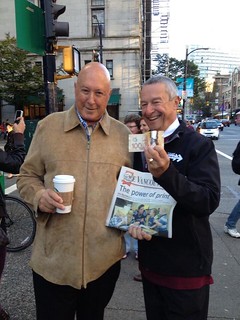
"Man buys copy of the Vancouver Sun from British Columbia's Education Minister with a fresh $100 bill donation to the newspaper's vital Raise-a-Reader literacy charity!"

Read all about it!

There's more to this picture (which was posted caption-less on the government's main propaganda website) than meets the eye. 

Minister Fassbender sells $100 newspaper!
Admen reunite: Palmer (left) and Fassbender (newsroom.gov.bc.ca)
If you follow B.C. politics, you probably know the man on the right is Peter Fassbender. He's the rookie Surrey-Fleetwood BC Liberal MLA who was re-elected Mayor of the City of Langley in 2011 (a post held since July by Ted Schaffer who was chosen by the rest of council to serve the rest of Fassbender's term).

Fassbender is a close friend of Deputy Premier Rich Coleman, who installed Fassbender as chairman of B.C. Pavilion Corporation, a post he held through the election.

Fassbender hit the streets on Sept. 25 to sell papers with news of a $500,000 donation from taxpayers to Raise-a-Reader, via Decoda Literacy Solutions, a spinoff of the secretive 2010 Legacies Now.

The man on the left is Frank Palmer, British Columbia's most-powerful and most-successful ad-man. He's the Palmer in Palmer Jarvis Advertising, which is now DDB Canada where he is chairman and CEO. 

Before he was a local politician in Langley, Fassbender was a business partner with Palmer at P.J. They go way back. In the 1990s, Fassbender was Palmer's right-hand man.  

Palmer, through an Alberta numbered company, 971261 Alberta Ltd., donated $2,500 to Fassbender's election campaign, which cost almost $200,000 (nearly double Premier Christy Clark's failed Vancouver-Point Grey campaign). Even while he was running for office, Fassbender remained the chairman of B.C. Pavilion Corporation, the taxpayer-owned company that runs B.C. Place Stadium and the Vancouver Convention Centre. Palmer is also a board member

Donating a C-note to a newspaper's charity is tame for Palmer. Last year, he dressed up as rapper Big Frankie P and recorded a track to benefit the National Advertising Benevelont Society, the ad industry's self-help charity. You could say he went from rap to fish-wrap.

Award-winning DDB was among six ad agencies on a pre-approved list of companies that the government called-upon from time-to-time over the last three years. During the most recent fiscal year, DDB billed the government $5.4 million and BC Hydro $11.7 million. DDB remains one of the government's go-to ad shops; it was included on an expanded, post-election list of 23 companies offering traditional, digital, video and polling services. Palmer's thoughts about procurement appear in Strategy, one of the Canadian industry's trade mags. 

Here's my Tyee reality check "Mad Men are always election winners" about the ad industry's relationship with the government and the ruling party. The Vancouver ad industry is reliant on government contracts, because it lacks the quantity of private sector corporate head offices that Toronto and Calgary boast. The government spent $36.4 million during the year leading up to the election. The re-elected Liberals would say it was money well-spent. Taxpayers? Not so much

Now you know a little more about a photograph on the government website. 

Tuesday, September 24, 2013

Coming in 2016: a value added tax at the urban resort?

Sept. 24, 2013 was the anniversary of Premier Christy Clark's announcement that her chief of staff Ken Boessenkool resigned for an "incident of concern."

It was another great day for euphemisms. Let's have two.

John Winter, the CEO of the British Columbia Chamber of Commerce, is lobbying for the resurrection of the Harmonized Sales Tax. Except he’s not calling it that. Nosiree. It’s a Value-Added Tax. Get it? 

According to Barbara Yaffe in the Sept. 24 Vancouver Sun
“Winter says the chamber is not trying to resurrect an HST debate, which he calls 'a nonstarter' in this province. 'What we are proposing is a way to leave our HST angst behind and move B.C. forward into tax dialogues.
"By not taxing business inputs, a VAT would allow B.C. to grow its prosperity by encouraging entrepreneurs, innovators and job creators."
In a June 8, 2010 Georgia Straight editorial ("HST is key to a strong economy in B.C."), Winter used the terms in the same sentence. 
“Experience in Atlantic Canada and other jurisdictions confirms that shifting to a value-added sales tax like the HST paves the way for increased capital spending on machinery, equipment, structures, new technologies, and other productive assets.”
The HST was imposed on British Columbians by Premier Gordon Campbell on July 1, 2010. It was announced July 23, 2009, just over two months after the BC Liberals won an election in which they vowed to be disinterested in giving B.C. a VAT. In the July 23, 2009 government news release, the HST was described as a VAT.
"More than 130 countries, including 29 of the 30 OECD countries, along with four Canadian provinces, have adopted taxes similar to the HST, called value-added taxes, which reimburse most businesses for the tax they pay on their inputs."
The HST was phased out March 31, 2013 after almost 55% of those who voted opted to extinguish the tax and return to the Provincial Sales Tax. 


Winter, by the way, knows a different kind of vat. He had a three-decade management career with Molson Brewery, including presidency of its Western Canada division. 

Also on Sept. 24, Paragon Gaming unveiled its plans for "Vancouver's Urban Resort."  This, two-and-a-half months after I broke the story in Business in Vancouver about financially troubled Paragon inking a revised deal with B.C. Pavilion Corporation to lease land next to B.C. Place Stadium. The original $6 million a year toward the $514 million stadium renovation will now be $3 million if the complex gets built. 

Yes, this Las Vegas company doesn’t want us to call it the proposed, $535 million new home of Edgewater Casino or a hotel/casino complex. Especially after Vancouver city council threw a curveball and quashed its bid to expand the 75-table, 600-slot machine casino to 150 tables and 1,500 slots in April 2011. Instead, it gave Paragon the go-ahead to move the existing licence to land for lease beside B.C. Place Stadium. Paragon's original $6 million-a-year, 70-year lease was cut to $3 million in a deal agreed to in March 2013. 

The 2011-proposed casino/hotel complex
Paragon revealed the architect's drawings for the casino complex.... er, urban resort... and its investors at a Sept. 24 news conference. Evidently my invitation was lost in the mail. 

I did some digging and found the company's CEO Diana Bennett and president Scott Menke registered a company called Paragon Holdings (Vancouver Resort) ULC on Aug. 8. They are the only directors of the company. Bennett and Menke are also the sole directors of Paragon Gaming Training School Ltd. Their Paragon Development is not to be confused with Paragon Development Inc. of Richmond, whose directors are Julie Chan and Terry Lai. 

The corporate registry doesn’t yet show executives of Paragon backers 360 Vox or Dundee Corporation as directors of Paragon Holdings (Vancouver Resort) ULC. 

The 2013-proposed urban resort... yeah, urban resort

Montreal-headquartered, TSX-V-listed 360 Vox is the umbrella for Enchantment Group Hotels, Resorts and Spas, Sotheby's International Realty Canada, Blueprint Global Marketing and 360 blu. Its asset management portfolio includes Fairmont Hotels including the Empress in Victoria, Olympic in Seattle, Chateau Laurier in Ottawa, Royal York in Toronto and Queen Elizabeth in Montreal. 360 Vox is also the project marketer for the CityCenter development in Las Vegas and developer of  two resorts in Dalian, China and three hotels in Cuba. 

Those Cuban properties are the subject of 360 Vox's $25.5 million lawsuit filed in Florida against the PGA of America. Vox 360 claimed PGA cancelled its licensing deal in December 2012 to use the PGA Village Cuba and PGA National Golf Academy Cuba names. 

Dundee Corp. owns 18% of 360 Vox and both companies are chaired by Ned Goodman who, according to the Globe and Mail, sleeps like a baby. Dundee, by the way, owns 58% of oil and gas exploration, development and production company Dundee Energy Ltd. and it owns 83% of Blue Goose Capital Corp., which bought the 14,052-acre Diamond S Ranch in Pavilion, B.C., for $14.8 million. Blue Goose, according to Dundee's annual report, is “focused on the production of clean protein.” (That’s another euphemism for another day.)

Vancouver Not Vegas coalition leader Sandy Garossino was not feeling enthusiastic about Paragon's euphemism. The casino development is not welcome and will be vigorously opposed, she said. Vancouver Not Vegas has already filed a petition, seeking a B.C. Supreme Court order to overturn city council's decision to allow the relocation.

“The people of Vancouver and Vancouver city council roundly rejected the first time this mega casino was proposed. Now we have the appearance of a smaller casino but there still has been no disclosure, there are still too many questions unanswered," Garossino said. "This is really an attempt to do an end run around city council. It makes no economic sense to do such a substantial development around a casino as small as the existing Edgewater is, it’s not going to anchor a development on a scale as being advanced here. We’re very skeptical this is the reality Vancouver is eventually going to have.” 

Yes, here comes another great casino debate about an urban resort.

Which is really just a value-added casino.

Friday, September 20, 2013

Sportsweekend: A peek at ViaSport, a scion of 2010 Legacies Now

A weekend special for those of any age who play, coach, referee, support, sponsor or watch amateur sports in British Columbia. 

A look at how ViaSport, the B.C. Sport Agency Society, is funded by taxpayers. 

What is today ViaSport was hived-off from 2010 Legacies Now, the mysterious quasi-non-governmental organization born during the bid phase for Vancouver’s 2010 Winter Olympics but continued through the Games as a funnel for community grants. 

2010 Legacies Now burned through a quarter-billion of your dollars over a decade without publishing a detailed list of who got how much. Its chair emeritus, Judy Rogers, is in no hurry to explain. (She hasn’t responded to my queries, but I would be glad to hear from her.) 2010 Legacies Now's central operations morphed into what is called Lift Philanthropy Partners, a nebulous "venture philanthropy" outfit.  

After the Games, Legacies Now spun-off its sport division to the newly created B.C. Sport Agency Society which was branded ViaSport and absorbed many of the functions of Sport BC, the umbrella for the province’s amateur sport system. 

HomeVANOC executive vice-president of sport Cathy Priestner Allinger organized ViaSport, whose first full-time chair was Moray Keith and CEO Scott Ackles. Keith resigned in late 2012 and Priestner Allinger became interim chair. With a change of government anticipated, Ackles’s job was terminated in March 2013. Priestner Allinger said she was not interested in the CEO job, but that was before she was passed over for the athletic director position at the University of B.C. (Scottish Swimming boss Ashley Howard got the gig in May.) Lo and behold, Priestner Allinger was appointed CEO by the ViaSport board that she helped choose; Caley Denton, the VANOC ticketing executive, was installed as the chair. 

Below is a May 31, 2012-dated Transfer Under Agreement between the Ministry of Community, Sport and Cultural Development and ViaSport to provide financial assistance for ViaSport to implement the Province's Five-Year Sport Strategy. Included is a financial report. You will not find any information like this on the ViaSport website. 

Schedule A, running from May 28, 2012 to March 31, 2013, states the government’s priorities for the funding are to foster participatory programs, high performance programs for "training to train" through "training to win" stages; and event hosting that supports sport, economic and community development.

Goals include increasing overall sport participation by 20% by 2015-2016 (above the 2008-2009 baseline data), increase active coaches and officials within each funded sport, enhance services through the Integrated Performance System and lead the sport sector by aligning with the spirit of health and education initiatives. 

ViaSport received four payments under the TUA: $885,000 (June 7, 2012); $7,905,360 (Sept. 19, 2012); $100,000 (Jan. 24, 2013); and $820,000 (March 6, 2013).

For 2012-2013, its net budget was $21,239,000 plus $1,292,000 spent by the Ministry’s Sport Branch. 

The biggest chunk of funding, $4,891,168, was earmarked to Provincial Sport Organizations, as part of the $10,090,050 participation envelope. High performance was budgeted $7,867,950.  

Thursday, September 19, 2013

Exclusive: EasyPark sues to recover missing $200,000

While it awaits the result of a criminal investigation, city-owned parking lot management company EasyPark is suing a Vancouver couple to recover more than $200,000 that it alleges was stolen by an ex-employee.

EasyPark’s Sept. 17 British Columbia Supreme Court notice of claim says Dan Chiu Keung Wong’s job was to empty ticket machine cash boxes into secure cash boxes, deliver the portable cash boxes to EasyPark’s secure treasury and report and account for all the cash boxes delivered.

But EasyPark claims that Wong stole funds from the cash boxes between 2008 and August 2012 and “altered or otherwise doctored the records of EasyPark to conceal his mishandling of the cash boxes, the portable cash boxes and his theft of the misappropriated funds.” 

“Dan was not authorized to and, as part of his employment with EasyPark, did not have the ability to open any of the cash boxes or the portable cash boxes,” said the lawsuit, filed by lawyer Peter Roberts of Lawson Lundell. 

EasyPark sued Dan Wong and his wife Angela Miu Kam Wong on Sept. 4, 2012 to seek return of the misappropriated funds plus interest. EasyPark received judgment on Sept. 16, 2013 against the couple for $203,037.95 plus $2,189.64 interest. The 1948-founded EasyPark, a non-profit public authority legally known as the Parking Corporation of Vancouver, manages 41 facilities with 10,836 parking spaces.

The claim says the Wongs bought a house on Jan. 4, 1993 on 3568 Tanner Street in Vancouver and jointly owned the property until June 22, 2005 when Dan Wong transferred his half interest to Angela Wong for a nominal $1 “and natural love and affection.” Since June 23, 2005, Angela Wong has been the only owner of the property, which has an assessed value of $787,200. 

The claim says the Wongs intentionally transferred the property to “defeat, delay, hinder and defraud” both Dan Wong’s existing and future creditors.

EasyPark chair Ransford
EasyPark claims Dan Wong “had accrued significant debts to creditors, including the Bank of Montreal and Royal Bank of Canada” and filed for bankruptcy on Jan. 30, 2006. He was discharged on Oct. 3, 2007. 

EasyPark wants the court to treat Dan Wong “as if he were still the legal and beneficial owner of the property” and grant an order for a certificate of pending litigation on the title of the property. 

The Wongs have not responded in court to the latest filing and the allegations have not been proven in court. A telephone message for the Wongs was not immediately returned.

In Dan Wong's Nov. 26, 2012 response to the Sept. 4, 2012 EasyPark lawsuit, he admitted he was employed by the company from January 2006 to Aug. 17, 2012, but denied misappropriating or converting the alleged misappropriated funds for his own use. That filing also said he was separated from Angela Wong.

EasyPark's Aug. 26, 2013 application for judgment against Dan Wong said the company retained KPMG Forensic to audit EasyPark records and determined there were $203,037.95 in "non-routine variances" between Jan. 1, 2010 and Aug. 18, 2012. "These non-routine variances in cash were 'most likely collected by Mr. Wong'," said the application.

The Aug. 26, 2013 EasyPark application said that "during the course of Dan's examination for discovery on June 27, 2013, an objection was raised to several relevant questions asked of him." 

One of the 10 objections raised was to this line of questioning by EasyPark's lawyer: "Mr. Wong gave evidence of a gambling problem. He was asked whether he ever borrowed money from friends, relatives or third parties for the purpose of gambling." 

EasyPark’s board chair told me in an interview that a criminal complaint was filed with the Vancouver Police Department. “Hopefully the police will deal with it to the full extent of the criminal law, but it’s in their hands,” said Bob Ransford.

VPD social media/media relations officer Sandra Glendinning said: "We will not speak to incidents that are currently under investigation, and we will not identify people who have not been formally charged."

Ransford said “procedures have been improved and tightened up” for employee background checks and money-handling at EasyPark. 

“This is an isolated case as far as we can tell,” Ransford said. “You want to know if there was any collusion or potential conspirators or other instances where this happened. There was a fair bit of audit work to rule that out.”

“Technology is moving us further and further away from the use of cash, and I think that’s a good thing, both from an efficiency point of view and controls." 

Note to readers: Do you have proof of significant fraud or theft in public-owned companies or government offices at any level? Only credible tips are welcome. Please contact me here. 

Tuesday, September 17, 2013

Vision Vancouver: openness promise made, promise broken

George Affleck to the rescue.

The former CBC reporter and producer, who runs a public relations agency called Curve Communications, was elected as an NPA city councillor in the 2011 election. Almost two years on, he has seen from the inside what those of us in the media have experienced on the outside.

Vancouver city hall, under the Vision Vancouver majority and leadership of Mayor Gregor Robertson, has become a closed shop. It has adopted the same corporate communications system for dealing with the media that exists under the proroguing Conservatives in Ottawa and the no-fall-Legislature-sitting BC Liberals in Victoria. This ranges from late replies to calls or emails from reporters seeking basic facts to the now-glacial Freedom of Information process that defaults to secrecy. No longer are we allowed to call a senior bureaucrat for an interview or even basic information. All requests must go through a central channel. Rarely are senior managers made available for interviews anymore. Instead, we get a crafted-by-committee paragraph or less statement that, sometimes, doesn't come close to being relevant.

Former city councillor and mayoral candidate Peter Ladner summed it up in this Business in Vancouver column. So did Stanley Tromp in The Tyee, who took a critical look at the ludicrous theatre that surrounds the open data movement, of which City of Vancouver claims to be a champion. As I like to say, it's nice to know where all the fire hydrants are, but how much did they cost taxpayers, who supplied them and how did they get the contract?

georgehead
Affleck: motion for openness
What is the reason why those in power feel the need to keep citizens in the dark and feed them excrement? The phenomenon of the permanent campaign. It's all about controlling the message and manufacturing consent. Those in power want to keep power. They use every available communications tool to control the message and prevent the slightest of embarrassment, every single day. And they do it on your dime. Their ultimate goal is to convince just enough of you to vote for them on election day, so that they can continue the cycle and satisfy those interest groups that donated to their cause.

Don't believe me? Denise Rudnicki is Canada's expert on the permanent campaign and how it is ultimately a detriment to democracy. Here's one of her shorter pieces: Inside the Government's Message-Making Machine.

Spending on communications has tripled at Vancouver city hall over the last seven years. The stakes are high. Vision Vancouver genuinely wants to see the Greenest City 2020 strategy that it imposed come to fruition in 2020. That means it wants another two election victories in 2014 and 2017, to go along with the 2008 and 2011 majorities.

Mayor Gregor Robertson
Robertson: promised transparency
Vision Vancouver might just succeed. It has created a formidable machine that appeals to those on the left, centre and right. It is where political donations from big unions and big business go. Without an effective opposition (NPA and COPE are still licking their wounds from 2011) the ruling party needs only to stay afloat in the daily news cycle until voting day, Nov. 15, 2014. Lo and behold, folks in neighbourhoods throughout the city are pushing back at Vision's habit of rubber-stamping rezoning and development of condos and bike lanes. A citywide protest march on city hall, called #OurVancouver, is planned for Sept. 24.

When he was sworn-in on Dec. 8, 2008, Mayor Gregor Robertson promised to "ensure transparency, accountability and public debate at city hall."

"I will not let you down on making city hall more open and accountable," Robertson said in his speech, which you can read here.

It is now 2013. Robertson has not delivered openness. He has let Vancouverites down.

Here is Affleck's motion. Watch out for the Vision Vancouver spin.

Media Access to City of Vancouver Staff 
Whereas the City of Vancouver values openness and transparency; 
Whereas media has an important role in communicating the actions of the City of Vancouver, and are crucial to ensuring informed, engaged citizens; 
Whereas the budget allocated to the Communications Department has increased from $1.25 million to $1.94 million, and staffing has increased from 9 to 20 positions over the past four years; 
Whereas local media have raised concerns regarding open access to officials, timely interviews with officials, and the ability to receive information on city policies; 
Whereas city departmental staff are professional, have good judgement and are generally very knowledgeable in their fields of expertise; 
Whereas past policy permitted city hall staff to communicate directly with members of the media at the discretion of their direct managers with no noticeable negative effects; 
Therefore be it resolved that provide a report to Council within three months which will explain:
  • 1)   Current policy relating to media access to Department Heads in the context of current global best practices;
  • 2)    Clear and concise policy around timely access to information by media; and
  • 3)    How the commensurate workload of the Communications Department could be monitored with the view of cutting costs in that department as part of continued efforts of the Shared Services Review. 

Sunday, September 15, 2013

Russian LNG behemoth coming to B.C. in 2015

Gazprom is coming to British Columbia. 

Not to buy liquefied natural gas -- Premier Christy Clark’s much-ballyhooed elixir for the future of the debt-laden province -- but instead to sponsor the biggest sport final in Canada since the 2010 Winter Olympics' men's hockey gold medal match.

GazpromOn Sept. 14 in the Winter Olympic city of Sochi, as Russian president Vladimir Putin looked-on, the world’s biggest LNG company inked a deal to become the official oil, gas and fuel sponsor of FIFA, soccer’s world governing body. 

The agreement runs 2015 to 2018 and is connected to Russia’s hosting of the 2018 World Cup
The 2015 Women’s World Cup, FIFA’s second-biggest tournament, is coming to Canada June 6 to July 5, 2015. The championship final will be played at B.C. Place Stadium in Vancouver

That means Gazprom’s logo will be seen on the pitch-level advertising boards and executives of Russia’s largest corporation will have the opportunity to enjoy a level 3 hospitality suite. The 2015 Women’s World Cup will be the biggest yet, with 24 nations represented, and matches in six Canadian cities. 

Tournament logoGazprom claims 18% of the world's natural gas reserves and to be the producer of 14% of the world’s LNG. Gazprom was once poised to export Russian LNG to the U.S., but the advent of fracking meant the U.S. didn’t need it. The Kremlin-backed company has staked its future on a pipeline to China. Gazprom signed an agreement to supply China National Petroleum Corporation on Sept. 5 at the G20 Summit in St. Petersburg. Witnesses included Putin and Chinese president Xi Jinping. Gazprom is also in talks to export Russian LNG to South Korea and Japan.

Clark will lead another trade junket to China, Japan and South Korea to flog B.C. LNG from Nov. 21-Dec. 3. (Academic research shows trade missions don't actually increase trade, but that's another story for another day.)

What happens to the investment of both private and public money in B.C. to develop an LNG industry if Gazprom meets China’s needs and if the Chinese find ample reserves of their own? What happens if Gazprom also finds buyers in South Korea and Japan? 

The word "shutout" comes to mind.

Friday, September 13, 2013

Exclusive: PNE day-by-day attendance revealed

The Pacific National Exhibition's 2013 Fair -- its 103rd to date -- was not marred by weather, but instead power outages at Hastings Park on the middle Saturday and the last Thursday. In fact, those were two of the worst days for attendance at the Aug. 17-Sept. 2 Fair, according to statistics that are  published below for the first time.


PNE - Pacific National ExhibitionWhat you already knew: The grand total over 15 days was 712,049, a decrease from the 763,689 a year earlier (when the fair was 17 days long) and far short of the 800,000 goal set by organizers. (By comparison, the centennial fair in 2010 drew 937,485.) PNE vice-president of finance Roger Gil told me gate revenue has not been reconciled, but will be reported to the board of directors for its next meeting. (PNE board meetings are held behind closed doors, despite it being a public body.)

What you didn't know: A power outage delayed the opening of gates on Aug. 24 so the attendance for the middle Saturday of the Fair -- traditionally one of the biggest days -- was a disappointing 48,874. Another power outage happened in the evening on Aug. 29. The day's weather was mixed -- partly cloudy, sometimes rainy -- but only 26,363 came through the turnstiles. That was the worst-attended day of the entire Fair. Organizers were hoping for more because Aug. 29 was the day Vancity credit union debit and credit cardholders were admitted for $5 each.

The best-attended day was the third day -- Tues. Aug. 20 -- with 76,902 fairgoers. Why was that? Well, Port Metro Vancouver sponsored free admission to all comers from 11 a.m. to 1 p.m. There was also a free two-hour promotion on Aug. 27, to make-good for the Aug. 24 power outage. That Tuesday's total  was 64,580.

Tickets and parking at the 2013 Fair were both cut from $20 to $16 each and kids under 13 were free. The touring Chinggis Khan exhibition, the only brand, new marquee attraction at the Fair, was an extra $3. There was no price break at the gates during the middle weekend of the civic fair, which was in competition with the free admission, civic-sponsored 125th anniversary of Stanley Park. The PNE drew 48,874 on Aug. 24 and 53,048 on Aug. 25. It is not known how much the free festival at Stanley Park impacted the PNE's revenues, but it certainly was not a business-wise move by the Vision Vancouver-dominated city council. The true anniversary of Stanley Park could have been observed on Sept. 27, the date it was opened in 1888.

The PNE fairgrounds were closed on Aug. 19 and 26 to cut costs.

Next year's fair runs Aug. 16-Sept. 1, 2014.

DayDateAttendance
SaturdayAugust 17, 201329,976
SundayAugust 18, 201331,129
MondayAugust 19, 20130
TuesdayAugust 20, 201376,902
WednesdayAugust 21, 201336,039
ThursdayAugust 22, 201336,594
FridayAugust 23, 201345,547
SaturdayAugust 24, 201348,874
SundayAugust 25, 201353,048
MondayAugust 26, 20130
TuesdayAugust 27, 201364,580
WednesdayAugust 28, 201333,499
ThursdayAugust 29, 201326,363
FridayAugust 30, 201341,126
SaturdayAugust 31, 201366,222
SundaySeptember 1, 201367,588
MondaySeptember 2, 201354,562


                                            TOTAL   712,049

What do you love or hate about Vancouver's annual PNE Fair? Did you go to the 2013 Fair? Leave your comments below or email me here.


Blog Archive