Showing posts with label Grey Cup. Show all posts

Friday, March 15, 2013

Two years on: her words don’t match the picture

Two years ago, on March 14, 2011, The Christy Clark Show: Taxpayer-Funded, Victoria Edition officially debuted. Political powerbroker Patrick Kinsella was among the guests in the live studio audience at Government House.

Premier Christy Clark
Christy Clark's swearing-in, March 14, 2011.
The Christy Clark Show: Taxpayer-Funded, Victoria Edition is a reality show that has been both a tragedy and a comedy. So many people are watching, despite the unpopular star and her supporting cast. The series will be cancelled as of May 14 if enough voters across this beautiful province go to the voting stations and (with the mark of an X on a ballot) figuratively say that they're mad as hell and not going to take it anymore

Conversely, Clark and Today's BC Liberals (not to be confused with Yesterday's BC Liberals or BC Christy) could be renewed for a four-year term. Stranger things have happened, but it is an extreme longshot, because March 2013 is only half over and it is shaping up to be as bad as, if not worse, than her March 2012. 

I said it before and I’ll say it again. March is the worst month to be a Premier in British Columbia. There is no “in like a lamb, out like a lion” maxim. If anything, it is a lacklustre month full of letdown for the person in the top elected office of the province. History shows the Premier is the author of his or her own misfortune.

March 2013 has been dominated by the Quick Wins Multicultural Outreach scandal, which actually began with the NDP's bombshell release of leaked Liberal election strategy documents on Feb. 27 (Clark's Pink Shirt Anti-Bullying Day). Clark's deputy chief of staff and closest confidant, Kim Haakstad, resigned March 1 because of it all. The Prince George plyscraper has received second billing on this month's scandal stage.

On March 4, Information Commissioner Elizabeth Denham slammed Clark for running an "oral government" in an investigation into the non-disclosure of records by the Premier's Office. On March 9, the Victoria Times-Colonist cited the Comox Valley Business Gazette's report on a February speech in which she poked fun at her ex-husband's manhood. On March 11, independent MLA John van Dongen fired his latest salvo at the Liberals over the unanswered questions about the BC Rail scandal and the Basi-Virk $6 million legal indemnity. 

The quagmire continued on March 15 (the Ides of March!) when Clark went to meet with the Christians at the B.C. Leadership Prayer Breakfast. 

Clark left without answering any questions from reporters about caucus chair Gordon Hogg’s pronouncement that he is in favour of an external investigation of the scandal. As opposed to the in-house review conducted by John Dyble, the deputy minister that she hired for his $310,000-a-year job

Dyble’s March 14-released, in-house review of his boss confirmed Liberals broke government rules by performing party work on government time for the taxpayers’ dime. There is no evidence that Dyble probed what the premier knew and when she knew. She only denied knowledge of the Quick Wins memo. 

Here is CKNW AM 980’s account of how the Premier -- a self-styled champion of public engagement and openness -- refused to answer reporters' questions. She may have said grace before breakfast, but she did not stay with grace after breakfast.

This is the same Clark who famously said during the last Question Period of the Legislative session on March 14, 2013:
“The essence of leadership is not to hide. It's not to run away.”
This is the same Clark who famously said in her March 14, 2011 swearing-in speech
“Our government will be open to the people of British Columbia. We will talk about our problems; we will set our priorities openly; and we will work with citizens to find solutions. And we will explain why we make the decisions that we do. You may not always agree with us and all the decisions that we make, but to the greatest degree possible, you won’t be surprised at the course that we take, and you will know for certain why we’ve chosen it.”
Many of us in the media are grudgingly accustomed to Clark hiding and/or running away. It is an unsettling trend. 

Two examples from 2012. 
Another from 2013: the day her cabinet met for an emergency Sunday meeting on March 3, Clark finally emerged from Canada Place for a quick two-minute scrum at 7 p.m., conveniently after the local supper-hour newscasts had signed-off. When politicians are confident and have a message they want to share with the public, they crave the chance to be on live TV. But on this night, embattled Clark was not ready for prime time. 

I have my own snubbed-by-Clark stories. She wouldn’t answer my question in the elevator lobby outside CKNW on Oct. 23, 2012 about her spending of taxpayer dollars on charter jets owned by CN Rail chairman and Liberal donor David McLean. 

Clark (left) and Dennis Skulsky, March 8, 2013.
I also tried asking a question on March 8 at B.C. Place Stadium, about how she could justify the $2.7 million subsidy to buy the Grey Cup hosting rights for 2014, while selling public assets to claim a balanced budget. Earlier, while at the podium, she looked right into my camera lens. But in the post-news conference mixed zone, she turned away and walked out before I could finish my sentence. I was standing less than 10 feet away and had unsuccessfully tried to gain her attention twice before. I was not alone. Laura Baziuk of CKNW had also hoped to ask a question.

This wasn’t the behaviour of Gordon Campbell when he was premier. His answers may have been insufficient at times, but he took questions and dealt with them. This was also not the behaviour of Clark when she was on the opposition side of the Legislature and actively sought attention from reporters.

Which brings me back to the March 8 news conference to announce the British Columbia government had bought the rights to host the 102nd Grey Cup in 2014. The Canadian Football League conducted no open, competitive bidding process, so it is incorrect to say hosting was awarded to the B.C. Lions and their owner, Sen. David Braley. The news conference had apparently been a rush job, to help the Liberals end a week on a high note after the Quick Wins scandal exploded.

When Clark arrived, she sat between Lions’ president Dennis Skulsky and legendary Leos' lineman Al Wilson. Liberal MLAs Richard T. Lee and Doug Horne and Deputy Premier Rich Coleman were also in the front row. All wearing B.C. Lions’ #14 jerseys. (Notice about 20 seconds into the video below how she greeted Coleman with a perky “Richie, hi!”) 

Vancouver Mayor Gregor Robertson was not invited to the news conference; the decision was apparently Skulsky's, but protocol should have dictated a mandatory invitation for top officials at Vancouver city hall. Robertson was invited to the Feb. 27, 2009 news conference when Campbell announced the 2011 Grey Cup would come to B.C. Place in Vancouver.

Clark, in fact, did not even acknowledge during her time at the podium that Vancouver would be the host city. (Fast-forward to the 19:00 mark of the CFL YouTube news conference video and follow the transcript below).

She made reference to Burnaby, but didn’t even say “Vancouver College” when she took note of the school's football players in the purple jerseys who carried the trophy into the news conference. She only said “V.C.”

Vancouver is the city in which she is an MLA (Vancouver-Point Grey, to be precise) and it is also the city whose taxpayers will get the bill for keeping the streets safe and clean in 2014. Cops, firefighters and sanitation crews don’t work for cheap, and they’re necessary for a successful event. 

Here is what she was supposed to say (notice the references to Vancouver):


Here is what she actually said (as seen on the video below, notice the lack of Vancouver references):
“Thank you very much, I'm absolutely delighted. And Travis (Lulay) and team, I know of course you can't guarantee we'll win it, I believe we will, and when we win it let's just promise we're not going to break it. What do you think? 
“Sen. Braley, I'm delighted to be here with you and all the great football players from VC. Thanks. I hope that some of you are going to have a great future in the CFL. 
“And Al Wilson, Jim Young, I grew up in a family of BC Lions fans, my grandfather was a season ticketholder, my father was a season ticketholder. I remember the days at Empire when we would go and we'd get free tickets to Playland afterwards.  
“This team has been a part of British Columbia families for generations. I'm just one example of that, and of course the original Lu, a fellow Burnabyite, who was a great representative for my city, for my province and made us all so proud.  
“Thank you to my colleagues who are here today as well.  
“British Columbia this month created 40% of the new jobs in the country. One of the ways that we did that is because we stayed focussed on job creation.  
"This is a great sporting event, it is a great source of pride for all Canadians, it is a tremendous opportunity for Canadians to come together and celebrate what makes this country tick.  
“But it's also a great economic opportunity for us. So when we made that over $2 million investment in bringing the Grey Cup to British Columbia, when we made that decision as a province, we did it because it would create jobs for people here. We know that the over $100 million in benefits that will come to british columbia are going to put a lot of people to work. 
“I'd say that's a great investment for our province, it's a great investment economically, but much more importantly, or just as importantly, it's a great investment in pride, in our pride.  
“I'm delighted, here we are at this incredible stadium, one that some said should never have been rebuilt. Well if there is proof that it was the right decision, it's this announcement today.  
“Because it's this stadium that's allowed us to be able to win the Grey Cup, it's been this great team, this fantastic organization this proud legion of fans and our bright history.  
“We're going to keep making history folks, we're going to win this Grey Cup. 
“We're not just going to win it with the right to host it, our players are going to win the right to hoist that cup again, out here on this field and give British Columbians something to cheer about. 
“Thank-you very much.” 
Here's what she was going to say:  
Footnotes: 
The B.C. government granted $2.7 million to B.C. Pavilion Corporation to bring another event to B.C. Place Stadium. The renovations to make this a (pardon the cliche) world-class stadium were supposed to help it sell itself to promoters. 
I can’t wait for another Grey Cup. I have attended all eight at B.C. Place, including the Lions' 1994 and 2011 victories. There is, unfortunately, no academic or scientific study to quantify the net economic impact of the game for the host city and province. Big sporting events rarely deliver what their boosters claim, according to the research of respected sports economist Victor Matheson. It is a fact that the Grey Cup is a boon for the hotel and hospitality industries wherever it is held. It would otherwise be a dull November weekend in Canada without the festival. 
I only question the wisdom of a taxpayer subsidy at a time when the public finances are in shambles and hospitals and schools claim to be underfunded. The Lions are privately owned by a wealthy senator who is a respected, skilled businessman that knows how to turn an investment into a profit. Why does he need more taxpayer help, especially when taxpayers were already dinged for the $514 million stadium renovation? 
Happy St. Patrick’s Day weekend. Enjoy the black beer, not the green. Be kind, not mean. Slainte! (I’m eager to see what kind of multicultural outreach activities the Liberals have up their sleeve!) 

Wednesday, February 29, 2012

Exclusive: B.C. sport shakeup

A new era in British Columbia sport will begin March 1 when Scott Ackles is announced as the chief executive officer of the B.C. Sport Agency.

It is part of an overhaul in the province's sport system in the wake of the 2010 Winter Olympics and Paralympics.

Ackles was the general manager of Vancouver's 2005 and 2011 Grey Cup festivals and replaces interim B.C. Sport Agency CEO Cathy Priestner Allinger, the Own the Podium blueprint author and VANOC executive vice-president of sport who was named last August to head of Vancouver's 2014 Special Olympics Canada Summer Games.

Ackles effectively becomes the most powerful executive in amateur sport in B.C. Former VANOC sport vice-president Tim Gayda has left his post as Sport BC CEO to be a consultant. Gayda's position will not be filled.

Sport BC and the B.C. Sport Agency will be working in concert for the betterment of sport in the province. The B.C. Sport Agency takes over management of programs that were under the wings of 2010 Legacies Now, such as the Aboriginal Youth Sport Legacy Fund and First Nations Snowboard Team. The former 2010 Legacies Now group rebranded as Lift Philanthropy Partners.

Saturday, November 26, 2011

Angus Reid: "Let's just enjoy it"


What the B.C. Lions have done to get to the Grey Cup is nothing short of miraculous. They opened the season with five straight losses. Since losing 30-17 to the Winnipeg Blue Bombers on Aug. 13 at home, B.C. has won 11 of 12 games. The team will ultimately be judged on the result of the 99th Grey Cup at home in B.C. Place Stadium.

This orange and black team can become the first Canadian Football League squad to win the Grey Cup on home field since the 1994 Lions beat Baltimore on Lui Passaglia's dramatic last-play field goal. That was also on a Nov. 27.

The Lions have battled a bad economy and new competition in the form of the Vancouver Whitecaps of Major League Soccer. Commentators speculated that the Lions would be overshadowed by both the Vancouver Canucks and Whitecaps. The Canucks were Stanley Cup losers and the Whitecaps mired in last-place with 18 losses to end their first MLS campaign.

"As players you can't approach a season on what media thinks who's going to be the biggest team in the league, how are we going to fit into the media circle and what are fans going to think of us? All we knew was we were losing games early on," said veteran centre Angus Reid.

"That's the beauty of this team: we never looked outside of the room, we had to pull together, we don't point fingers, we don't cannibalize each other...

"Look at what's happened. The media's behind us, the city's rallied behind us. That came with us doing our jobs as football players, not worrying about public image."

Not only is the game an opportunity for the 2011 Lions to become one of the greatest teams in CFL history, but it could also further the healing for a city bruised by the June 15 Stanley Cup riot. The last time the Canucks lost in the Stanley Cup and fans rioted, the Lions won the championship at home.

"There's going to be almost 60,000 people in one building that will be filtering out together. That's a recipe for anything. I'm not going to compare CFL fans with NHL fans, because a lot of that wasn't sports fans, they were just idiots being idiots," Reid said.

"We can take this opportunity as a city and prove that we can have a mass amount of people here involved in a massive sporting event, where I'm sure there will be alcohol involved, and I'm sure there will be all the fuel you'd need to be a bad situation and, yet, we have it be a joyous celebration regardless of outcome."

"It's a great event, let's just enjoy it for what it is and prove that this is a city that can have great things here and not screw it all up."

Oh, say can you see?


The official sellout of the 99th Grey Cup game, announced in July, was 52,511. B.C. Place Stadium is said to hold a maximum 54,500. But will every seat truly be occupied on Nov. 27?

While the panoramic view can be described as spectacular, the renovation of the stadium left hundreds of seats near the top of level 4 with obstructed views. From some seats, only one of the two end zones is visible. You may also not be able to see the giant, centre-hung, shoebox-style video board for replays. The first, and often second, aisle seat in the top four or five rows of level four is impeded by structural columns.

If you have aisle tickets in rows VV-ZZ on level 4, you should contact TicketMaster or the Grey Cup committee. (Then email me to tell me about your experience.)


Monday, November 21, 2011

Occupy eviction intended to protect Grey Cup bank

What's really behind the City of Vancouver’s rush to disband Occupy Vancouver’s camp from the bark mulch and concrete of the Vancouver Art Gallery’s north plaza?

Grey Cup Festival organizers fear protesters could disrupt the Nov. 26 Grey Cup parade and embarrass a major sponsor. The B.C. Supreme Court granted an injunction that allows police to evict protesters if they don't remove tents and structures from the Vancouver Art Gallery's north plaza by 2 p.m. Nov. 21.

No Grey Cup events were planned for the VAG plaza, where the protest began Oct. 15, and the Saturday morning parade route uses Burrard Street. There is no intelligence that such a protest would happen and Occupy Vancouver has not made a public statement against the Grey Cup festival or its sponsors. But a source involved with the 99th Grey Cup game organization indicated that nobody wants to risk embarrassing Scotiabank.

The Occupy movement’s protest targets have included banks. In Vancouver, locations of TD Canada Trust and RBC have been protest sites. Occupy protesters have also picketed against Enbridge, the company that wants to build a pipeline between the Alberta tarsands and coastal British Columbia to carry oil for export to Asia. Aboriginals opposed to the proposed pipeline attended the Scotiabank annual general meeting in Halifax last April. A Yinka Dene Alliance news release claimed Scotiabank raised $10 billion for Enbridge.

The newly re-elected Vision Vancouver-dominated city council enacted restrictive measures before the 2010 Winter Olympics to protect VANOC sponsors. No similar bylaws are in place for the Grey Cup. Mayor Gregor Robertson and his opponent Coun. Suzanne Anton are among the Grey Cup Committee members.

Planning for the Grey Cup Festival has been complicated by the ugly legacy of the June 15, 2011 Stanley Cup riot. The 1966 Grey Cup parade was a night-time affair and revelers rioted with Vancouver Police and RCMP outside the Hotel Georgia and courthouse (now the art gallery).

Freedom of Information requests for agendas and minutes of the large events oversight committee, central management team and Grey Cup committee have been denied in-full by the City of Vancouver.

Sunday, November 20, 2011

Riot redemption or Eskimo jinx?

The Edmonton Eskimos are back in Vancouver for the third time in less than two months to seek their first win under the new roof at B.C. Place Stadium.

If they win Nov. 20, they will get a chance the next week to get their second win -- in the 99th Grey Cup.

The more times the teams play on the new synthetic turf field, the greater the odds that the Eskimos will finally win one. But will that win spoil the B.C. Lions’ ambition to finish the season as the home team in the Grey Cup?

Edmonton has rained on the parade before. Enough that you might suggest there is a green and gold jinx.

Every time the Lions have met the Esks in the West final of a B.C. Place Grey Cup hosting year, the Esks have eliminated B.C.

Nov. 23, 1986: Esks 41-Leos 5 in Edmonton (Mike Kerrigan and the Hamilton Tiger-Cats beat the Esks 39-15 in the Grey Cup).
Nov. 22, 1987: Esks 31-Leos 7 in Vancouver (Gizmo Williams and the Esks beat the Toronto Argonauts 38-36 in the Grey Cup.)
Nov. 20, 2005: Esks 28-Leos 23 in Vancouver (The Danny Maciocia-coached Esks beat the Montreal Alouettes 38-35 in overtime to win the Grey Cup).


What’s more, the Calgary Stampeders eliminated B.C. on Nov. 21, 1999, 26-24 at B.C. Place. The Stamps returned the following week to lose 32-21 to Darren Flutie and the Ti-Cats.

Could the Stanley Cup riot be a good omen?

The last year in which the Vancouver Canucks were losers and fans reacted by rioting in downtown, the Lions beat an Alberta team in the West final and won the Grey Cup at B.C. Place.

The Lions edged the Stampeders 37-36 in dramatic fashion in the snow at Calgary on Nov. 20, 1994. On Nov. 27, 1994, Lui Passaglia kicked the game-winning field goal on the final play to beat Baltimore 26-23. That remains the greatest sports moment in the history of 1983-opened B.C. Place and, arguably, the greatest 20th century moment in Vancouver sports history.

Vancouver was rocked by another Stanley Cup riot when the Canucks were losers on June 15, 2011.

Can the city end this year with a home-won Grey Cup as consolation?

Friday, October 14, 2011

Gorby vs. Christy: statesman vs. eternal talkshow host


Oct. 13, 1986 was the closing day of Vancouver’s Expo 86. The world exposition on transportation and communication. I was there, all the way until the end, roaming the empty, closed site one last time. From end-to-end.

Twenty-five years later I was in two venues that didn’t exist at the time: Rogers Arena, built in 1995 near the site of Expo 86’s giant flag, hockey stick and puck and Vancouver Convention Centre West, opened in 2009 to be the international broadcast centre for the 2010 Winter Olympics. The east wing was built as the Expo 86 Canada Pavilion.

At Rogers Arena, it was Free the Children’s annual We Day. A day of inspirational speakers and hopeful messages for the leaders of tomorrow. With what passes for today’s top 40 music between the speakers.

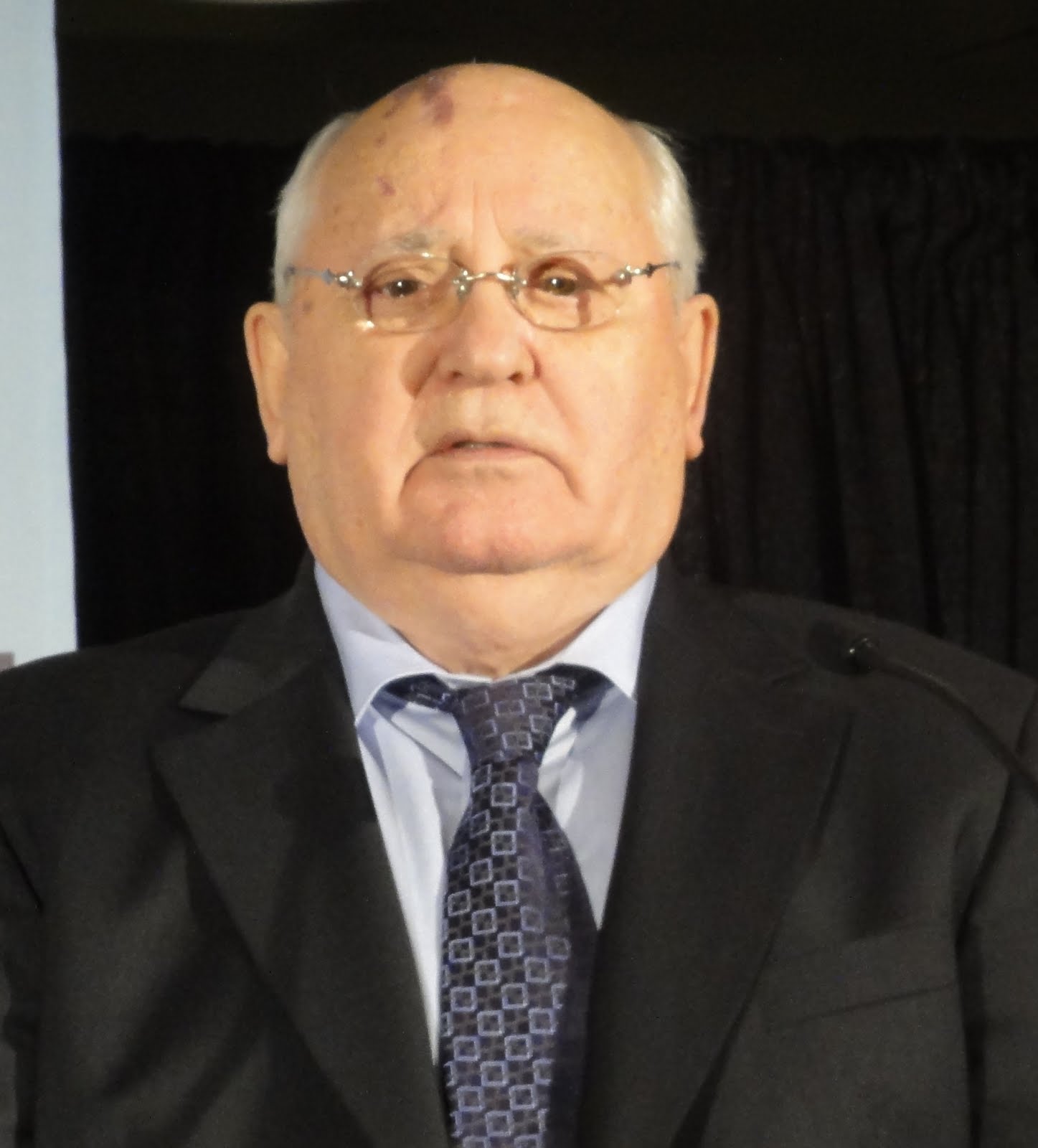
Among the speakers was Mikhail Gorbachev, the last president of the Soviet Union from 1985 to 1991. A man who changed the world and won the Nobel Peace Prize on Oct. 14, 1990. I was among the minority of people in the arena who was alive when Gorbachev was in power. (I also remember one of his previous Vancouver visits, when Nardwuar the Human Serviette made him laugh.)

Gorbachev, who turned 80 earlier this year, told the youth audience, through his translator, that the hopes of the world after the Cold War have not been fulfilled. The world is troubled by terrorism, poverty and an environmental crisis.

“The global financial crisis that was caused by the greed of a few people is being resolved at the expense of ordinary people, ordinary people who are not to blame for that crisis,” he said.

He said we're on the cusp of a new arms race that could be more dangerous than the last one.

His most poignant message?

"Never despair… never panic. Unite," Gorbachev said. "Don't allow anyone to deceive you. Don't allow anyone to exploit you."

After his speech, he came to a news conference. Reporters were crestfallen when told by a We Day organizer that the news conference would last only 10 minutes. We got angry when the moderator cut it short. Both Gorbachev and his interpreter briefly pleaded with their hosts for more time! Imagine that, a career politician who did not want a press conference to end!

That bought him a few more minutes, but it was still not enough. A great statesman deserves more time. A man who changed the world deserves more time.

He was asked for his thoughts on the Occupy Wall Street movement. During his presidency, people in the Eastern Bloc risked their lives and took to the streets to demand better government and better jobs. It even influenced the short-lived pro-democracy movement in China that ended so violently at Tiananmen Square on June 4, 1989.

"The constitution of your country, the constitution of our country, the constitutions of all democratic countries contain democratic rights, including the right to protest. In Russia, we know that there are people, including people in government, who don’t like it when people protest in the streets and when they present their demands by demonstrating. And sometimes there are even bad consequences and even clashes as a result,” Gorbachev said.

“We have to be wary, though, of certain extremist elements who are trying to turn these just demands and just protests in a certain direction to exploit those movements. Nevertheless, those elements are an exception. People today are more confident when they act; they are more confident of the rightness of their demands and their actions.”


In the afternoon, I attended a news conference to announce the Grey Cup festival in Vancouver, where the star attraction was not the Grey Cup (it wasn’t there) or the Vanier Cup (which was there), but Premier Christy Clark. The B.C. Liberals “jersey girl” added a Grey Cup souvenir jersey to her collection. She even dropped a football, in a neo-Stanfieldian moment. (My camera was unfortunately not rolling.)


This is what she had to say about the Occupy Wall Street movement coming to Vancouver on Oct. 15:

"Canada is a profoundly different place than America. When we look south of the border and see what's going on there, we feel pretty grateful that we live here, in a country where we have a thriving middle class, where we have a large degree of equity and social justice. I think groups that want to try and start up something like Occupy Wall Street here aren't going to see the same kind of success. We are a fundamentally different country from America. We are a fair country, we're not always perfect, there's no question about that, but this is a country that is a whole lot fairer than almost any other country in the world. I think when you live in a country like this it's a lot harder to recruit people to groups like Occupy Wall Street than it is in other countries in the world where maybe they don't have the same kind of equity that we have here."


Translation: Be a good Canadian. Be deferential to the powers that be. You have it good, don't demand better. Don't complain or ask questions.

After a scrum that lasted exactly four minutes and 52 seconds, Clark turned her back and walked away. My shouted question about the upcoming first anniversary of the end of the notorious "Basi-Virk" government corruption trial didn’t prompt her to turn around. Instead it made her walk away faster, into a nearby ballroom.

Before her tenure as a CKNW talkshow host, Clark was deputy premier when BC Rail, a taxpayer-owned railway, was privatized in a fishy deal with CN Rail in 2003. A deal which sparked the famed bribery trial of ministerial aides David Basi and Bob Virk, which shockingly ended on Oct. 18, 2010 with a plea bargain and the government agreeing to pay Basi and Virk’s $6 million legal bills.

Here’s my story on the first anniversary and renewed calls for a public inquiry by the men who know the scandal the best: Bill Tieleman and Alex Tsakumis.

While the Occupy Wall Street movement encourages discourse about the role of governments and corporations, British Columbians should never forget the scandal which dominated the news for most of a decade. The BC Rail corruption scandal was the most egregious example in this province's history of government cozying up to corporate interests and losing sight of its responsibility to the people. A public asset was sold in sordid fashion and none of the politicians involved has offered a full and complete explanation about how and why the deal went down.

Premier Gordon Campbell said it was only about two men who admitted their guilt. His successor Clark has parroted the line. She has refused calls for a public inquiry.

Are they telling the truth or was this a massive cover-up? Were Basi and Virk the only perpetrators or were they patsies?

The reality is government has to buy from and sell to private companies. If a tendering process cannot be transparent when it demands transparency or be secret when it demands secrecy, why should the taxpaying public or private companies have any trust in government? Until "BC Railscam" is fully understood and government integrity rescued, citizens will remain skeptical of any case of any private-public partnership, privatization, subsidy or bailout.

Contrast Clark's behavior with that of Gorbachev, a man of courage, willing to spend more time to take more questions. During his presidency, he was a politician who wanted less power, not more, in a country with a nasty history of megalomania (read: Stalin). Gorbachev is not universally admired in Russia. Many of his compatriots wish the Soviet Union still existed. Others are thankful they could taste some freedom, but want less corruption and more democracy from today's leadership duo of Dmitry Medvedev and Vladimir Putin.

Gorbachev wanted the people to take a deep breath and shape their own future, not politicians. "Glasnost" (openness) and "Perestroika" (restructuring) were the hallmarks of Gorbachev's administration. What a concept? They mean so much more than Clark's "jobs" and "families" mantra. Without openness and restructuring, how can families enjoy prosperity?

If people don’t trust their government to listen to the people, then people take to the streets in protest. A protest like Occupy Wall Street. Or Occupy Vancouver.

Blog Archive